So what's really important in designing material handling equipment from corporate specifications?

ELECTRICAL STANDARDS
Electrical systems shall be designed to the established corporate electrical standards to ensure operator safety, clarity, maintainability, and long-term reliability.
Power & Distribution
- Incoming power matches site voltage, phase, and frequency
- Phase indicators required on all three-phase systems
- Clearly identified, lockable disconnects supporting LOTO
- Physical separation of high-voltage and low-voltage circuits within enclosure
Control Panels & Enclosures
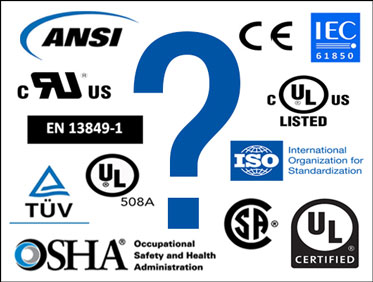
- UL 508A certified control panels
- UL listed or recognized components
- Enclosures sized for wire routing, heat dissipation, and future expansion
- Environmental ratings (NEMA/IP) appropriate to conditions
Wiring & Protection
- Clearly labeled wires and terminals
- SCCR ratings documented and coordinated with facility available fault current
Safety Circuits
- Designed to PLd or higher (per risk assessment)
- Implemented with certified safety relays or safety PLCs
- Redundant, monitored circuits with documented validation
Approved Components & Controls
To support standardization and maintainability, equipment must use approved or pre-qualified components, including:
- PLCs, HMIs, drives, and safety controllers
- Sensors, scanners, photo-eyes, and encoders
- Motors, gearboxes, actuators, valves, and pneumatics

MECHANICAL DESIGN
Mechanical designs must prioritize safety, product protection, durability, cleanability, obsolescence risk, availability, and standardization across sites.
Structural Design & Fabrication
- Tubing must be closed and sealed at both ends
- Where practical, replace hollow tubing with plate or channel construction
- Product Contact & Protection
- Areas that may contact product require:
- Continuous welds, and/or
- Stainless steel or food-grade plastic sheeting to protect product
Product Contact & Protection
Areas that may contact product require:
- Continuous welds, and/or
- Stainless steel or food-grade plastic sheeting to protect product
Stored Energy & Maintenance Safety
- Stored energy sources identified and controlled
- Verification of zero pump pressure prior to maintenance
- Locking pins/restraints required to secure moving components during maintenance or entry into unsafe zones
Lubrication & Service Points
- Grease points accessible without defeating guards
- Grease covers required with Lexan for visibility

ASSEMBLED COMPONENTS
Fasteners and hardware must be standardized to ensure structural integrity, maintainability, identification and contamination control.
Thermal & Acoustic Controls
- Hot surfaces (manifold, motor, oil tank) identified and guarded where contact is possible
- Motors and drives must meet defined dB limits
Hoses, Fittings & Access
- Hoses and fittings routed and supported to prevent damage
- Utilities and isolation points clearly identified
- All maintenance access points clearly labeled
Fasteners & Hardware
- Fasteners must be either standard (imperial) or metric per site/corporate standard
- Do not mix standard and metric fasteners on the same equipment
- Hardware length appropriate to material thickness and application
- Excessive thread exposure is not permitted beyond engagement and locking requirements
- Thread-locking compounds (e.g., Loctite) or mechanical locking devices required where vibration exists
- Corrosion-resistant fasteners used where required
- Metal-detectable zip ties/wire ties required in applicable areas
- Fastener grades, materials, torque values, and locking methods documented
GUARDING & RISK
Risk management, and proper guarding are foundational to safe, reliable equipment operation and cannot be treated as secondary considerations.
Guarding & Machine Safety
Equipment must meet or exceed corporate EHS requirements and applicable safety standards.
- Fixed or interlocked guarding for moving hazards
- Accessible emergency stops
- Safety devices designed to prevent bypassing
- Clear visibility and ergonomic access where possible
Risk Assessment & Compliance
A documented machine risk assessment is mandatory. Risk does not transfer from the buyer to the OEM or integrator. The end user retains responsibility for ensuring equipment is safe, compliant, and suitable for its intended use.
We coordinate risk assessment activities with independent third-party agencies as required, including:
- UL
- TÜV
- Omron
- Other accredited functional safety organizations
Deliverables typically include:
- Formal risk assessment report
- Safety function descriptions and validation records
- Third-party review documentation, where applicable

INSTALLATION & ACCEPTANCE
Installations may be governed through a centralized Installation Clearinghouse for compliance. Acceptance tests to ensure safety, readiness, and consistency across all facilities.
Pre-Installation Requirements
- Scope, utility, and site readiness review
- Site hazard review and mitigation planning
- Contractor Qualification & Insurance
- Verification of insurance coverage and Certificate of Insurance (COI)
- Contractor compliance through ISNetworld and/or Avetta, as required
- EHS & Readiness Sign-Off
- LOTO verification and energy isolation confirmation
- Validation of guarding and safety systems
- Final EHS, engineering, and facilities approval prior to commissioning
Factory Acceptance Test (FAT)
- FATs are required unless formally waived.
- Objectives
- Verify functionality and performance
- Validate safety circuits and guarding
- Confirm documentation readiness
- Outputs
- FAT checklist and results
- Open-issue log and corrective actions
- Approval to ship
Site Acceptance Test (SAT)
- SAT confirms operational readiness in the production environment.
- Scope
- Utility and interface verification
- Functional testing under production conditions
- Operator and maintenance training
- Acceptance Criteria
- Performance requirements met
- FAT issues resolved
- Documentation approved

DOCUMENTATION
Documentation is required to support maintenance, troubleshooting, long-term asset management, and to maximize uptime and minimize unplanned downtime.
Documentation
Required Documentation
- Electrical and mechanical drawings
- Software backups and configuration files
- Safety circuit diagrams and validation records
- Operation, maintenance, and troubleshooting manuals
- Spare parts lists
- Installation, commissioning, and acceptance records
All documentation must be revision-controlled and delivered prior to final acceptance.
Uptime, Reliability & Support
- Designed for continuous industrial operation
- Defined reliability expectations where applicable
- Access to critical spares
- Clear warranty and support escalation paths